
Fans for heat treatment: performance and durability in high-temperature systems
One of the most significant issues in a heat treatment department is the presence of non-conforming batches or distortions after quenching. This problem goes far beyond a simple technical inconvenience, resulting in wasted raw materials (both in terms of resources and costs) and delays in operational activities.
Often, the analysis of these non-conformities focuses on thermal calibration or on the quality of the furnace itself, underestimating the influence of internal ventilation. If the fans inside heat treatment systems do not ensure perfectly uniform circulation, the atmosphere cannot reach every point of the load with the same effectiveness, creating dead zones that compromise the entire batch.
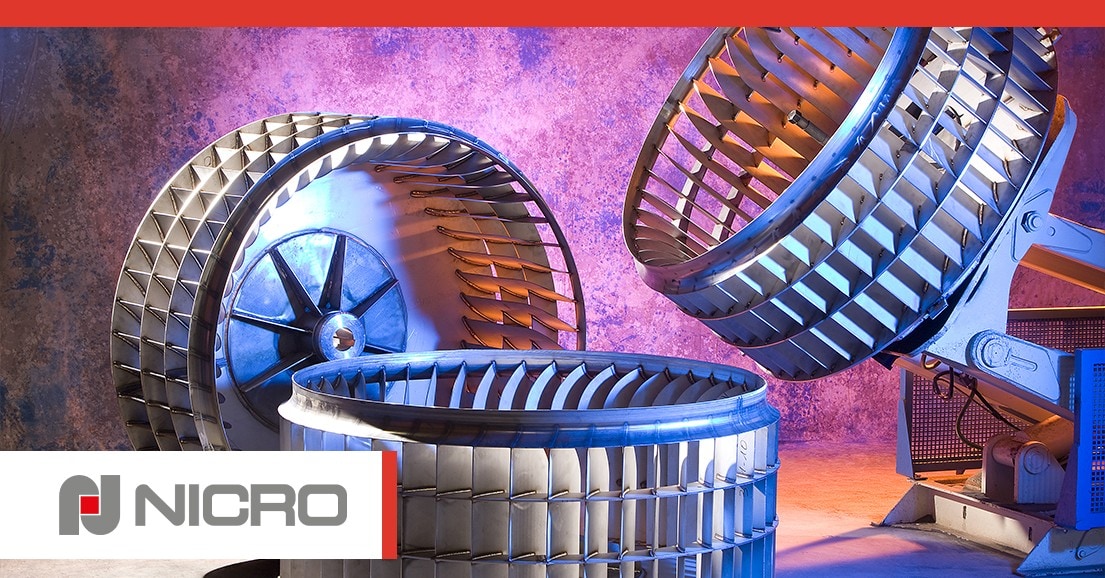
Precisely because we are aware of the importance of these components, so often underestimated, at Nicro we approach the manufacturing of heat treatment fans as the engineering of a critical asset for the stability and repeatability of your production output.
The Vital Role of Fans in Thermal Uniformity
The primary function of convection fans is to generate and maintain a controlled airflow inside the furnace, whether it is a bell-type or a muffle furnace. Typically, the flow starts from the top, moves downward along the walls, and is then recirculated within the treatment chamber. This air movement has a dual effect: it helps make the furnace temperature more uniform and ensures an even distribution of the gases present in the process atmosphere. Without forced and continuous circulation, thermal gradients could develop, reducing the repeatability and uniformity of the treatments, especially in more sensitive processes.
Examples include:
- Carburizing and carbonitriding, treatments widely used in the automotive sector, precision mechanics, and the production of transmission components. In these processes, it is important that temperature and atmosphere are distributed uniformly within the working volume of the furnace so that all parts exposed to the same conditions develop a hardened layer that is as uniform as possible across the surface.
- Quenching, annealing, and normalizing, operations commonly used in many industrial sectors, including aerospace, oil & gas, and marine. In these treatments, the management of temperature and the heating or cooling phases influences the final properties of the material. Proper air circulation helps maintain uniform thermal conditions inside the chamber, promoting more consistent results among the different parts being treated.
Nicro manufactures fans are designed to withstand these stresses, transforming a rotating component into a precision asset capable of raising the operational standards of clients with specific requirements.
High-Performance Materials for Extreme Conditions (Above 1100°C)
Working in environments where chemical corrosion is constant, such as in the petrochemical and steel industries and where temperatures regularly exceed 1000°C requires deep metallurgical expertise. In these scenarios, fans operate in contact with carburizing or nitriding atmospheres that attack conventional metals: only the use of certified alloys can prevent embrittlement and structural failure of the component.
Nicro fans are manufactured using austenitic and super-austenitic alloys selected for their superior chemical and physical properties:
- AISI 310 and Avesta 253MA, ideal for ensuring long operational life thanks to their exceptional resistance to oxidation and high temperatures.
- Incoloy 800H, chosen for its structural stability, preventing permanent deformation (creep) under mechanical load at high temperatures.
- Alloy 617, used in extreme cases where the combination of thermal stress and chemical attack requires performance beyond common standards.
This careful material selection, combined with the possibility of using differentiated thicknesses, makes it possible to produce fans capable of withstanding the specific centrifugal stresses of each application.
Process Engineering: From 3D CAD to Thermomechanical Simulation
At Nicro, quality is not an abstract concept but the result of a documented and traceable process. Our technical department uses 3D CAD design software to simulate the mechanical and thermal behavior of the fan even before production begins.
This approach allows us to offer high value-added services such as Reverse Engineering: we are able to recreate fans starting from worn components, improving the original design to enhance performance or extend the service life of the part in direct collaboration with the customer. Every phase, from the selection of the welding process to the final verification, is guided by our Integrated Management System (IMS), which brings together ISO 9001, 14001, 45001, and 50001 standards into a single model of operational efficiency.
Balancing and Reliability: The Secret to Operational Continuity
One of the main enemies of furnace longevity is vibration. A fan that is not perfectly balanced can damage shafts, bearings, and motors, causing costly and unexpected downtime.
To prevent these risks, Nicro includes in every order:
- Static and dynamic balancing, performed in-house on dedicated test benches to guarantee the absence of harmful vibrations.
- Certified welding quality (ISO 3834-2): ensures the quality of the final product through controlled processes, material traceability, and qualified welding procedures.
- Non-Destructive Testing (NDT): our qualified technicians perform penetrant testing (PT) and radiographic testing (RT) to detect even the smallest anomaly invisible to the naked eye.
Choosing Nicro heat treatment fans means relying on a partner that looks beyond the supply of a single component. Thanks to our ability to produce custom solutions (up to 1800 mm in diameter) and the rigor of our certified processes, we deliver products that minimize risks and maximize return on investment.
Raise the standards of your plants. Contact the Nicro design team today to receive specialized technical consulting and discover how our special alloy solutions can improve your operational efficiency.


