
Restoration Engineering for Bell Furnaces: Structural Repair of Steelwork Bases and Convectors
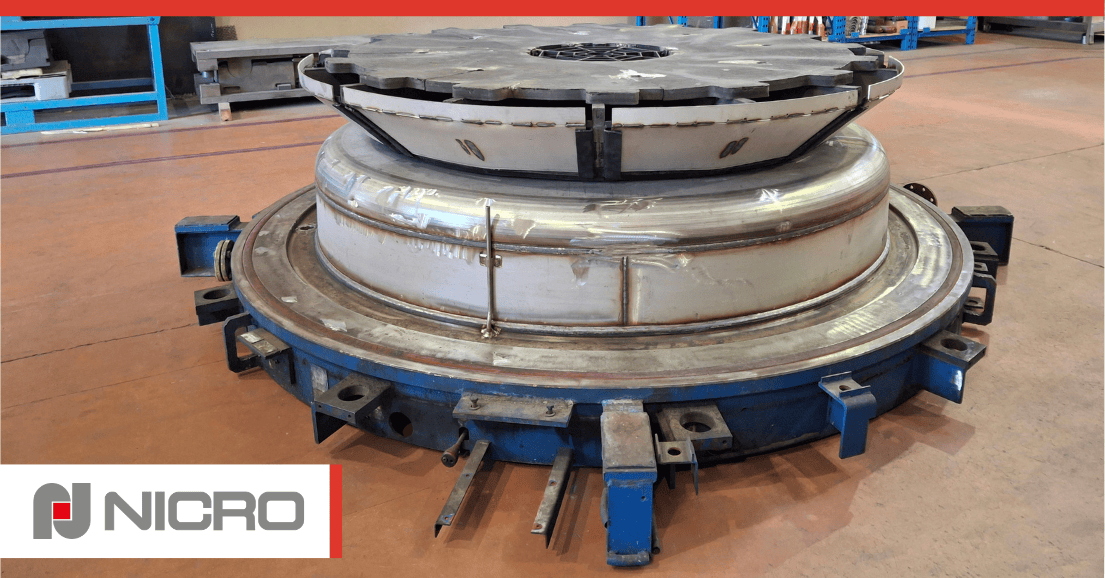
In the steel industry, coil annealing cycles subject the internal components of bell furnaces to continuous thermomechanical stresses. The combined action of heavy static loads and high thermal gradients accelerates fatigue and creep phenomena. In this context, the maintenance approach cannot be limited to simple standard replacement, but requires localized restoration interventions and the use of high-alloy materials to restore the original geometric tolerances and thermal exchange efficiency.
A recent multi-level repair operation, performed on an annealing furnace base and its supporting flow convector, highlights the metallurgical and construction dynamics required to extend the operating life of the original equipment.
Analysis of the Multi-Level Intervention: Base and Convector Restoration
The convector, positioned directly above the furnace base, acts as a support interface for the coils and as a heat exchanger for the recirculating gas flow. Areas subject to wear and plastic deformation require localized reconstruction interventions or complete replacements. The operation involved the disassembly and overhaul of individual parts, replacing the most worn components:
- Removal of deformed components and replacement of side plates and retainers using 5 mm shaped sheets made of AISI 321 alloy.
- Use of AISI 321 titanium-stabilized austenitic stainless steel, selected for its resistance to chromium carbide precipitation within the to temperature range.
- Reconstruction of the convector’s central grid in AISI 316Ti alloy, a stabilized stainless steel suitable for enduring mechanical and chemical stresses in harsh industrial atmospheres.
Thermomechanical Reconstruction of the Annealing Furnace Base
The bell furnace base manages the static load and houses the lower cooling circuits, making it an assembly exposed to asymmetric thermal gradients. The structural intervention on the furnace base unfolded across several operational phases:
- Reworking of cracked welds, identified on the base framework via preliminary grinding followed by re-welding using compatible filler metals.
- Replacement of the deteriorated outer shell with a new 6 mm sheet made of W.st 1.4828 heat-resistant stainless steel, equivalent to AISI 309.
- Restoration of the under-base cooling channel, executed by temporarily removing the ten structural reinforcement ribs to allow access and replacement of the duct.
- Complete rebuilding of the insulation and ceramic refractory package to reduce thermal transfer toward the lower structural parts.
Joining Technologies and NDT Quality Control Protocols
The quality of welded joints on heat-resistant materials prevents premature cracking or structural failure under load. The reliability of repaired hot components is verified through rigorous testing and inspection procedures:
- Execution of controlled automatic welding to ensure bead homogeneity and consistent penetration on heat-resistant sheets.
- Pressure testing performed on the base cooling channel to verify the complete leak-tightness of the circuit.
- Application of dye penetrant non-destructive testing (NDT) on every welded joint and heat-affected zone to detect micro-cracks or discontinuities.
NICRO is at your company’s service with dedicated engineering support and reverse engineering services for the maintenance and restoration of industrial furnace components. You can contact our technical department to evaluate feasibility and the most suitable metallurgical criteria for your specific plant requirements.


